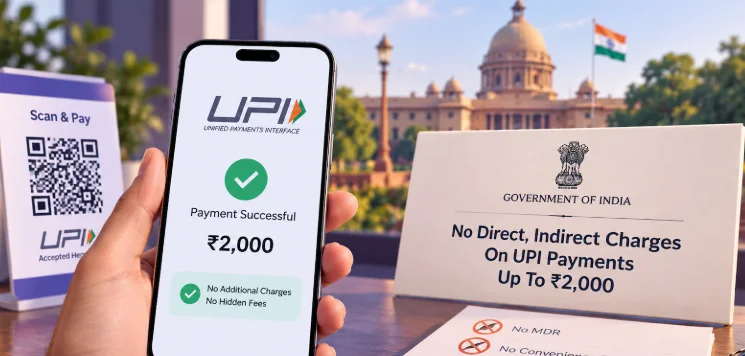
NEW DELHI, Sept 15: The government has directed banks and payment system providers not to levy any charges on Unified Payments Interface (UPI) transactions of up to Rs 2,000 or payments made through RuPay debit cards.
However, the government has not yet specified whether a Merchant Discount Rate (MDR) will be imposed on UPI transactions exceeding Rs 2,000. At present, UPI transactions remain free of charges irrespective of the transaction value.
According to a gazette notification issued on September 14, no bank or payment system provider can impose, either directly or indirectly, any charge on a person making or receiving a payment through a RuPay debit card or a UPI transaction of up to Rs 2,000.
The notification follows an amendment to Section 10A of the Payment and Settlement Systems Act, 2007, providing an enabling framework for imposing MDR on UPI and other notified electronic payment modes.
The amendment Bill was passed by Parliament during the Monsoon Session, which concluded on August 13. Following its passage, the government said the UPI and Services Steering Committee, headed by the National Payments Corporation of India (NPCI), would decide the MDR rates.
The government has said the proposed charges are aimed at supporting the expansion and long-term sustainability of the digital payments ecosystem. With transaction volumes increasing rapidly, the system requires continuous investment in cybersecurity, fraud prevention and infrastructure, it said.
It also said that a sustainable revenue model was necessary to encourage greater competition and enable more companies to expand their operations. Reliance solely on subsidies was not considered viable for the next phase of growth, the government said.
A balanced framework is therefore needed to ensure that UPI remains robust, inclusive and future-ready, it added.
UPI is operated by the National Payments Corporation of India (NPCI), an initiative of the Reserve Bank of India and the Indian Banks' Association. The platform enables real-time payments between individuals and allows customers to make direct payments to merchants.
UPI has also expanded its international footprint and is currently accepted in 11 countries, with Uzbekistan being the latest addition. The other countries include Singapore, the UAE, France, Mauritius, Nepal, Bhutan, Qatar, Sri Lanka, Cambodia and Greece.
Launched on August 25, 2016, UPI has transformed India's digital payments landscape. Its transaction value rose from Rs 0.07 lakh crore in FY17 to around Rs 314 lakh crore in FY26, marking an increase of more than 4,000 times over the past decade.