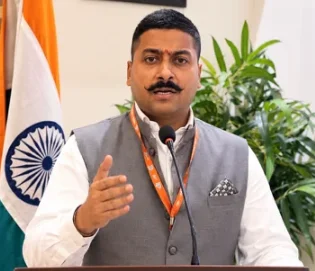
BJP Spokesperson and Convenor, International Affairs, J&K, Gaurav Gupta, today launched a sharp attack on the Congress over its criticism of the upcoming BRICS Summit, saying that the opposition’s attempt to undermine an important international event exposes its own lack of clarity on India’s growing global stature.
Gupta said that the most revealing aspect of the ongoing debate is that Congress itself appears divided on BRICS. While senior Congress leader P. Chidambaram has questioned what tangible benefits India has received from recent BRICS meetings, Congress MP Shashi Tharoor has described India’s hosting of the summit as an important opportunity and highlighted the significance of BRICS as a platform for the Global South.
“Congress should first decide what its position on BRICS actually is. On one side, its senior leaders are questioning the usefulness of the grouping, while on the other, its own MP Shashi Tharoor is acknowledging the strategic importance of BRICS and India’s role in the Global South. This contradiction exposes the political mindset behind the criticism,” Gupta said.
He said that India is hosting the 18th BRICS Summit in New Delhi on September 12 and 13, at a time when the grouping has expanded considerably and represents a major platform for emerging economies. India is chairing BRICS in 2026, with the summit being held at Bharat Mandapam.
Gupta asked the opposition to look at the history of India’s economic transformation before attempting to create a negative narrative.
“Let us not forget where India stood in 2012. At that time, Goldman Sachs Chairman Jim O’Neill had described India as the least attractive BRIC economy in valuation terms. He also cautioned that India, China and Russia could find it difficult to sustain the exceptionally high growth rates of the previous decade. Yet, even then, he acknowledged that India could turn around if it pursued the right reforms,” Gupta said.
Gupta said the contrast between 2012 and 2026 tells a much bigger story than political criticism.
“Then, questions were being raised about India’s growth prospects. Today, India is chairing and hosting an expanded BRICS grouping and bringing major global leaders to New Delhi. The very platform whose relevance some opposition leaders are questioning has grown in international importance, while India’s role within it has become far more significant,” he said.
He said BRICS has evolved from the original Brazil-Russia-India-China grouping into a much broader platform that now includes countries such as Egypt, Ethiopia, Iran, the UAE and Indonesia, reflecting the growing influence of emerging economies.
“Political differences within any multilateral grouping are natural. Even the BRICS foreign ministers’ meeting in May 2026 exposed differences among members. But that does not mean India should undermine its own diplomatic platform. The correct approach is to use India’s chairmanship to advance Indian interests, strengthen economic cooperation and enhance our voice in the Global South,” Gupta said.
Taking a direct swipe at the Congress, Gupta said “The Congress should decide whether it wants to celebrate India’s global rise or search for reasons to criticise it. When Shashi Tharoor himself recognises the importance of BRICS, what exactly is the Congress leadership trying to oppose?”
He said the growing international attention around the Delhi summit is itself evidence of India’s enhanced diplomatic weight.
“In 2012, India was being asked whether it could realise its potential. In 2026, the world is coming to Delhi to engage with India. This is the difference between the India of yesterday and the confident India of today. The opposition should acknowledge this transformation instead of trying to manufacture negativity around every achievement of the country,” Gupta said.
Gupta urged political parties to keep national interest above partisan politics and said India’s global engagement should be viewed through the lens of national interest, economic opportunity and strategic influence, rather than narrow political calculations.