Jammu, Aug 13 : A year after the devastating cloudburst and flash floods at Chasoti in the foothills of Machail Mata shrine in Jammu and Kashmir's Kishtwar district, Sashastra Seema Bal Head Constable Hussan Dass is left with an irreparable loss of his close relatives -- his wife, two children, mother, sister, two nephews and sister-in-law.
For 38-year-old Dass, the tragedy is not merely a statistic but a daily struggle to rebuild a life shattered within hours, leaving his home in Benagarh village of RS Pura sector in Jammu deserted and mostly locked, a haunting reminder of the family he lost.
The last time Dass, who was posted in Bihar at the time, saw his children was on August 14, 2005, on a video call when the family was returning from the Machail Mata shrine after paying obeisance. He had no way of knowing that the brief video call would become his last glimpse of them.
"I had a video call with my children on the morning of that fateful day. They were returning after paying obeisance at the shrine," Dass told, his voice heavy with emotion as he struggled to hold back tears, reflecting the stoicism forged through years of tough training.
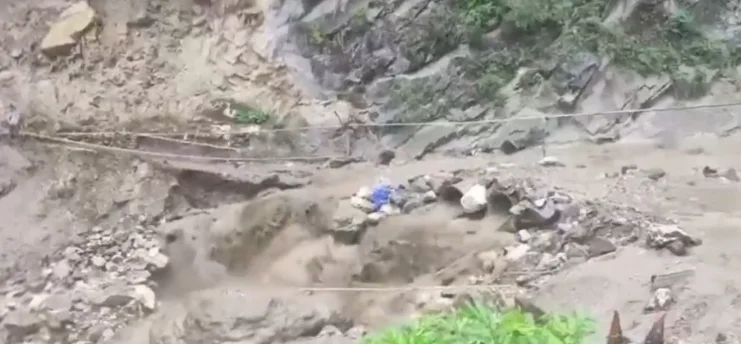
A few hours later, at around 12.25 pm, Chasoti -- the last motorable village on the route to the Machail Mata temple -- was hit by a sudden cloudburst, triggering flash floods and landslides.
The sudden water current gushed through the settlement, destroying a makeshift market, a langar serving pilgrims, and a security outpost, leaving behind a trail of death and destruction.
After the video call, Dass said he left for duty at around 9 am. And more than three hours later, he heard about the tragedy.
"I desperately tried to contact my family, but their phones were switched off," he said, adding that the silence that followed became the defining sound of the past year.
Dass's family had travelled to Machail Mata on August 12. Among them were his wife Mumta Rani (35), daughter Anansi Mehra (8), son Arshil (5), and mother Jeeto Devi (72). His sister Jinny Devi (42), her son Ritik Mehra (10) and daughter Pehu (15) of Bishnah, and sister-in-law Rahi Mehra (32) of Resham Garh were also with them.
"They were my family. Only my wife's body could be recovered, while the whereabouts of the others remain unknown," he said.
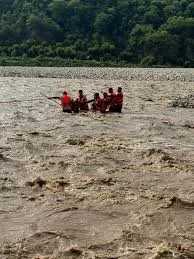
The Sashastra Seema Bal, Dass said, did not stand aside. "My unit moved and joined the search for the missing, but they could not be found," he said.
Search teams combed through the affected area for more than one month, but there was no final farewell for the missing members.
An RTI application filed by Jammu-based activist Raman Kumar Sharma with the Kishtwar district administration has provided an official snapshot of the disaster.
According to the reply shared by Sharma , the district administration confirmed the death of 63 persons, 127 injured and 30 others missing following the tragedy.
The RTI reply also stated that Rs 2.52 crore was sanctioned under the State Disaster Response Fund for the deceased, calculated at Rs 4 lakh per deceased person.
Dass said he received compensation only for his wife because her death alone could be established through documentary proof. No relief was given for the rest.
The RTI application had specifically sought details of compensation and ex-gratia released to the families of the deceased and injured, as well as details of the steps taken to recover missing persons.
The response, however, does not provide all the documentary details the applicant sought.
For Dass, the issue is not just about money. "No compensation can bring them back," he says. What remains is the struggle to live without them.
After the tragedy, Dass said, he is left with his father Mangal Dass, aged 80.
The family that once included his children, parents, siblings and spouse has now been reduced to a much smaller circle, leaving him with responsibilities he never had to bear alone before August 14 last year.
He said he must continue his service, care for his ageing father and somehow carry the immense emotional burden of losing almost his entire family.
"For a man in uniform, duty does not stop because life outside work has fallen apart," he said, adding that he still has to fulfil his responsibilities even when the pain of his personal loss follows him.
Dass said he remains grateful to his organisation for posting him close to home, allowing him to stay with his ailing father, and shoulder his responsibilities at a difficult time.
The SSB jawan's brother-in-law Sonu Kumar, who lost his wife, son and daughter, said he had a deep foreboding when his family left for the pilgrimage.
His wife had said that she had already visited the temple twice and that this would be her "third and final" visit -- words that turned prophetic and therefore, haunting.
Kumar said he has received the death certificates of his family members though their bodies remain untraced, but has not received any compensation so far.
"Initially, we held on to the agonising hope that they might still be found alive, but as the days passed, that hope slowly faded, leaving us struggling to come to terms with the unbearable loss," he said.
Senior BJP leader and Leader of Opposition in the Jammu and Kashmir Legislative Assembly Sunil Sharma said the tragedy remains an "unforgettable and deeply painful memory", regretting that the families of those missing are yet to receive compensation due to the six-year rule, despite repeated demands for relaxation.
Sharma, who had camped in the affected area throughout the rescue and relief operations since it falls within his Assembly constituency, said the rehabilitation, reconstruction, restoration and safety works were underway with the National Hydroelectric Power Corporation and a non-governmental organisation coming forward with assistance.
He urged the government to immediately extend financial assistance and other benefits to the families of those still missing, noting that after a year, the chances of recovering their bodies from the Chenab river had become virtually impossible.