India’s first hydrogen train: Salient features
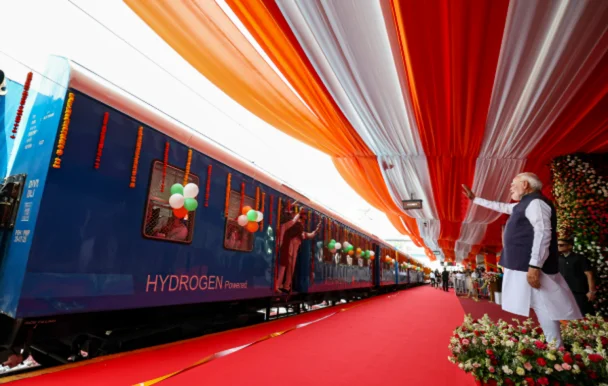
New Delhi: Prime Minister Narendra Modi on Friday flagged off India's first hydrogen-powered passenger train from Jind railway station in Haryana, marking a significant milestone in the country's push towards clean and sustainable transportation.
The train will operate between Jind and Sonipat, covering the 89-kilometre route in about two hours with halts at 12 intermediate stations.
Powered by a 1,200-kilowatt hydrogen fuel-cell propulsion system, the 10-coach train has a maximum speed of 75 kmph. Unlike conventional electric trains that rely on overhead power lines, the hydrogen-powered train generates electricity onboard through hydrogen fuel-cell technology.
Hydrogen stored in high-pressure tanks reacts with oxygen inside the fuel cell to produce electricity, with water vapour being the primary by-product. The hydrogen fuel is produced separately, compressed, transported to the refuelling station and then filled into the train's storage tanks.
The train has been equipped with multiple safety features, including hydrogen leak detectors, heat sensors and an automatic hydrogen shut-off system that can isolate the fuel supply without human intervention in case of an emergency. The driver's cabin has also been specially designed with enhanced safety measures and includes an emergency operating mode that allows the train to be moved to a safe location if required.
Officials said the hydrogen-powered train offers several environmental advantages over diesel locomotives. It eliminates tailpipe emissions, significantly reduces noise pollution and lowers dependence on fossil fuels and imported petroleum products.
Unlike conventional electric trains, it does not require continuous overhead electrification infrastructure, making it a viable clean-energy solution for routes where electrification is difficult or uneconomical.
Hydrogen fuel cells typically convert hydrogen into electricity with an efficiency of around 50 to 60 per cent, while hydrogen production through electrolysis generally achieves an efficiency of 60 to 70 per cent, depending on the technology used.
The use of green hydrogen, produced using renewable energy, is expected to further reduce dependence on electricity generated from fossil fuel-based thermal power plants, supporting India's clean energy and net-zero goals.
The hydrogen refuelling infrastructure includes hydrogen production or supply facilities, compression systems, high-pressure storage tanks, dispensing equipment and advanced safety mechanisms to ensure safe handling and operation of the fuel.
The launch of the country's first hydrogen-powered train is seen as a major step towards adopting next-generation, environmentally friendly railway technology in India.