By Ravish Handoo
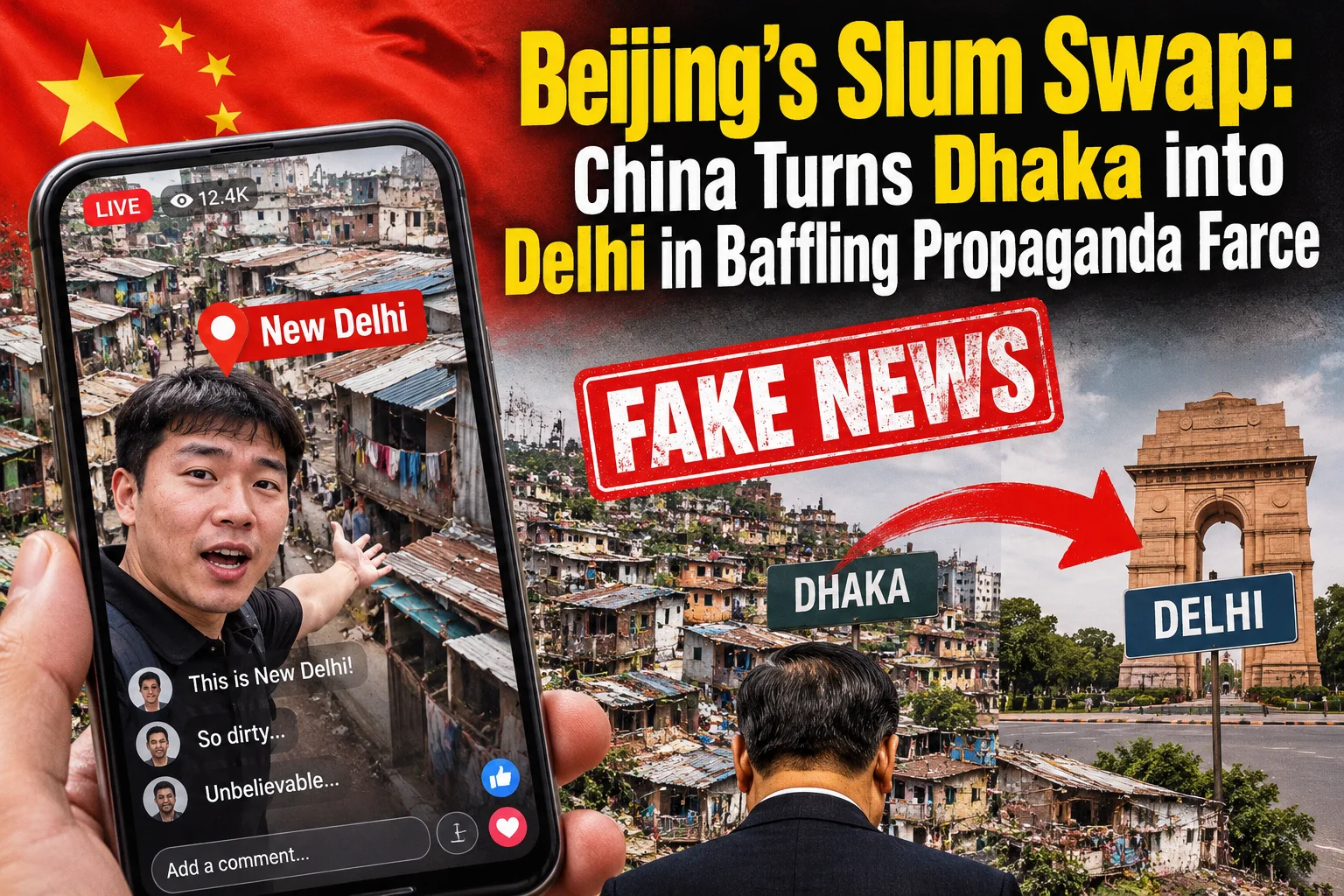
In a bizarre twist of digital deceit, Chinese “influencers” have recently been livestreaming from impoverished neighbourhoods of Dhaka and fraudulently labelling the scenes as parts of New Delhi. India’s External Affairs Ministry was quick to condemn the stunt as “unfortunate” and a baseless distortion, warning that peddling such falsehoods “only undermines the credibility” of those behind them. The victims of this scheme are not India or China as countries, but ordinary Bangladeshis - Tekpara and Uttara residents whose slums have been co-opted as props. According to Bangladeshi press investigations, roughly 150 Chinese nationals were involved in the filming for months, all the while falsely claiming they were in “New Delhi”.
These reports have now been verified by multiple sources. The Times of India and Hindustan Times both recount Bangladeshi media (notably Prothom Alo) tracking these vloggers in Uttara’s Sector 12 and nearby slums. NDTV’s reporting, confirms that “at least 150 Chinese vloggers filmed Tekpara and Uttara neighbourhoods for months,” carrying two phones (one for streaming, one for notes) while spewing derogatory commentary about “India”. The content is cruelly scripted: one streamer, “Mianmian,” pointed to tin-roof houses and sneered, “This is New Delhi. Their homes are filthy. There isn’t even a fan inside the tin-roofed houses,” calling the area “underdeveloped, dirty and unhygienic”. In another clip, a man named “Wang Wei” mocked local tea as “cow urine tea”. Residents complain the film crews even trespassed into homes (and sometimes bathrooms) without permission. As one woman, Rozina Khatun, told Prothom Alo, “Sometimes they enter our homes and start filming… We are not always properly dressed… Imagine how it feels when someone suddenly walks into your home and starts recording.”.
Whatever their motive, the pattern is unmistakable. New Indian Express aptly describes this as a coordinated anti-India campaign, not a random prank. The production values (long hours, dual cameras, paid local guides) and uniform messaging (India as “dirty” and “slum”) suggest at least an organized network. (Indeed, journalists on the ground found Bangladeshis like Ritu Akhter serving as guides, earning ~Tk 700–800 a day to shepherd the Chinese into the poorest lanes) This strategy recalls larger patterns in disinformation. Tech platforms and researchers have documented sprawling pro-China networks (e.g. the “Spamouflage” campaign) that borrow real images and repeat bigoted tropes to sway foreign audiences. While no public evidence ties today’s vloggers to Beijing’s government, their approach “deliberate attribution of another country’s locations,” as New Indian Express puts It, mirrors the playbook of state-linked influence operations. Their misrepresentation of Bangladesh as India is a new front in this online “information war,” even if China’s official media has stayed silent.
India’s response must be tough but principled. So far, the government has summoned official protests and urged Bangladesh to crack down on the perpetrators. This should continue diplomatically: New Delhi should privately share all available evidence (satellite images, timestamps, witness accounts) with Dhaka and press them to enforce local laws against illegal filming. At the same time, India should take the campaign public. Every doctored video must be debunked with facts, geolocation analysis, expert commentary and side by side comparisons, widely disseminated on social and traditional media. Official spokespeople have already flagged the misinformation (“We have seen media reports… unfortunate”); they should now release comprehensive rebuttals showing the true locations.
On the tech front, India should enlist platform accountability. Chinese social apps (Douyin/WeChat) have limited reach outside China, but the videos inevitably leak to global networks (YouTube/TikTok/X), where they should be reported and removed. India can work with big-tech (and friendly governments) to pressure platforms to crack down on these offending accounts and videos, citing community standards on misinformation. Meanwhile, New Delhi should invest in media literacy at home: citizens must be alerted to check sources and remain skeptical of sensational livestreams. The government (and NGOs) can run public advisories explaining Dhaka≠Delhi and urging viewers to look up corroborating news. At the same time, it must avoid overreach: legitimate criticism of India should not be censored. The goal is to silence dishonest attacks, not stifle free speech.
Crucially, India’s tactic should be to uplift truth, not feed xenophobia. This means shielding Bangladeshis from blowback: we should acknowledge that Bangladesh is the victim here, too. Indian messaging can underline that Dhaka’s residents never consented to be used as props in this propaganda and India respects Bangladesh’s sovereignty. Bilateral cooperation can be offered: for instance, India might assist Bangladesh in regulating suspicious foreign media crews or in tracking digital footprints (since Prothom Alo and local police admit they don’t know who is directing these broadcasts). This isn’t a time for India to beat war drums; it’s a time to present clear evidence and build international consensus that China’s social-media gambit is a baseless smear.
In the end, the most befitting reply is to let transparency and progress do the talking. India should continue highlighting its real achievements from clean water drives to urban sanitation projects and contrast them with the lies. Ironically, these flimsy videos may backfire on China: educated audiences will see through the hoax and sympathize with Bangladesh. Meanwhile, India’s decisive rebuttal will signal that it is neither easily fooled nor quietly cowed. By responding with calm logic (and a healthy dose of sarcasm), India ensures that this episode only reinforces its resilience. Beijing’s stunt may have aimed to slap India’s image, but it has instead put its own credibility on trial. Truth is on India’s side, and a forthright, fact-based counter campaign will ultimately speak louder than any talking-head lie.