
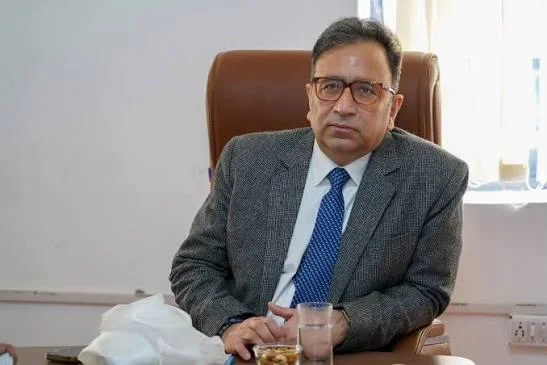
Leh: Ladakh needs to have a single-window clearance system to simplify the process of setting up and operating enterprises, Chief Secretary Ashish Kundra said on Wednesday.
Kundra held a review meeting on the startup policy of Ladakh, which focuses on financial incentives and the implementation framework, a single-window mechanism aimed at strengthening the startup ecosystem and providing structured support to entrepreneurs across the Union Territory.
"There is a need to establish a single-window mechanism for startup-related clearances, including those involving SIDCO, pollution control and other regulatory agencies, so as to simplify the process of setting up and operating enterprises in Ladakh", Kundra said.
Officials from the Entrepreneurship Development Institute of India (EDII), associated with the implementation of the startup policy, made a detailed presentation on changes introduced in the financial incentive and support framework based on the principle that a uniform support mechanism may not adequately address the requirements of enterprises at different stages of development.
According to officials, the revised framework provides for a structured four-level enterprise support mechanism covering different stages of the startup journey, along with dedicated financial support windows for ideation, seed funding and founder support.
It also incorporates expanded eligibility and entry provisions, a common scorecard-based assessment mechanism with progressively higher benchmarks, streamlined procedures for different financial instruments and safeguards to ensure responsible utilisation of public funds, they said.
Reviewing the revised provisions, Kundra stressed the need to make the policy simple, accessible and outcome-oriented, particularly for young entrepreneurs and early-stage enterprises in Ladakh.
He suggested examining the possibility of rationalising the four-level framework into three stages by appropriately merging the growth and scale categories, while retaining adequate support for ideation and early-stage ventures.
The chief secretary emphasised strengthening support during the initial stages of enterprise development, particularly for ideation, prototype development and early-stage operations.
He also stressed the importance of founder support and ensuring that eligible startups have access to patent-related assistance, including provisions for domestic and international patents, as applicable under the revised policy.
On eligibility and assessment, Kundra called for a transparent and inclusive mechanism for startups registered under the recognised Startup India framework.
He also emphasised an effective screening and appraisal mechanism involving appropriate district-level structures so that deserving entrepreneurs can access support without unnecessary procedural delays.
The meeting also focused on developing a user-friendly digital platform through which startups can register, submit applications, access information on available schemes and track their applications.
The chief secretary stressed integrating registration, appraisal and disbursement processes through a streamlined digital mechanism.
The proposed linkage of the startup support framework with J&K Bank's interest-subvention and lending mechanisms was also reviewed.
Kundra directed the concerned officials to work out the operational framework for the loan component, fund management and submission of interest-subvention claims.
He stressed the need to promote responsible credit access for young entrepreneurs and explore convergence with existing initiatives such as Mission YUVA, wherever feasible.
He directed officials to examine successful models adopted in other states and Union Territories and assess their suitability for Ladakh.
The institutional framework for incubation and entrepreneurship support was also discussed.
Kundra directed concerned departments and the implementing agency to further refine the implementation mechanism in accordance with the revised policy provisions and ensure effective coordination among all stakeholders.
The startup policy should provide a clear and accessible pathway for entrepreneurs, from ideation and product development to enterprise growth and scaling, while creating sustainable opportunities for the youth of Ladakh, he said.