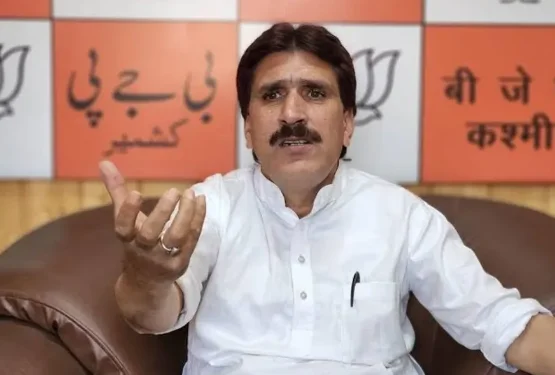
Srinagar, Sept 11: Senior BJP leader and BJP J&K spokesman Altaf Thakur on Friday launched a blistering attack on the National Conference (NC), accusing the party of selectively interpreting Kashmir’s political history while ignoring what he described as its own record of political suppression.
Reacting to recent remarks by NC chief spokesperson Tanvir Sadiq, Thakur said the party could not claim a monopoly over Kashmir’s history or present itself only as a victim of political developments.
“NC’s history is not a story of victimhood alone. It also has chapters of political suppression, intolerance towards dissent and the marginalisation of rival voices. Those chapters cannot be erased for political convenience,” Thakur said.
Thakur said the political narrative being advanced by the NC needed to be examined against historical records and contemporary accounts.
Referring to Walter Lawrence’s The Valley of Kashmir, Thakur pointed to observations on the material conditions of Kashmiri villagers. He said Lawrence had written that, in some respects, the Kashmiri was better off than his counterparts in other parts of India, referring to the availability of grazing for sheep and cattle, fuel for winter, warm clothing and manure for cultivation.
“History cannot be reduced to slogans. If the NC wants to invoke history, it must also be prepared to accept the historical record in its entirety,” Thakur said.
He said the transformation from the Muslim Conference to the National Conference under Sheikh Mohammad Abdullah was a crucial turning point in Kashmir’s political history.
“People must ask why the Muslim Conference was transformed into the National Conference and how the political space for those who disagreed with Sheikh Abdullah subsequently shrank,” he said.
Thakur also referred to Mirwaiz Yousuf Shah, saying his exile was an important episode involving a prominent political and religious voice outside Sheikh Abdullah’s camp.
“The political history of Kashmir cannot be understood by discussing Sheikh Abdullah alone. Mirwaiz Yousuf Shah and other competing political voices are equally part of that history,” he said.
Taking aim at the Halqa-e-Khawateen, Thakur said the organisation, which functioned as the women’s wing associated with Sheikh Abdullah’s National Conference, went beyond conventional political mobilisation during the turbulent years of the late 1940s and early 1950s.
He said sections of the organisation were used to intimidate and publicly humiliate political opponents and people suspected of supporting rival political groups.
“Political mobilisation is one thing, but intimidation of opponents is another. The history of the Halqa-e-Khawateen and the treatment of political dissenters deserve an honest examination,” Thakur said.
He said opponents were subjected to public humiliation and intimidation, while women and families associated with rival political camps were also targeted.
Thakur said such episodes could not be brushed aside simply because they involved a political organisation that later became one of the dominant forces in J&K politics.
“The same party that lectures everyone today about democracy must answer questions about how dissent was treated when it was itself at the height of its political power,” he said.
The BJP spokesman accused the NC leadership of trying to create a selective version of Kashmir’s past in which its own political contribution was highlighted while the experiences of its opponents were ignored.
“Tanvir Sadiq and his political masters cannot pick convenient pages from history and discard the rest. Kashmir has a long and complicated political history, and every voice—whether belonging to the NC, Muslim Conference, Mirwaiz camp or any other political stream—deserves to be placed before the people,” Thakur said.
He said the younger generation should be encouraged to study original historical records instead of relying on politically curated narratives.
“Truth does not fear scrutiny. If the NC is confident about its historical legacy, let it open every chapter for debate. Kashmiris are mature enough to distinguish between history and political propaganda,” Thakur said.
He said the BJP would continue to challenge what he called the NC’s “selective history” and place before the people records and accounts that, according to him, provide a broader picture of Kashmir’s political evolution.
“Those who built their politics around a particular version of history cannot now demand that uncomfortable chapters be forgotten. Kashmir’s history belongs to its people, not to any political family,” Thakur said.