By Ravish Handoo
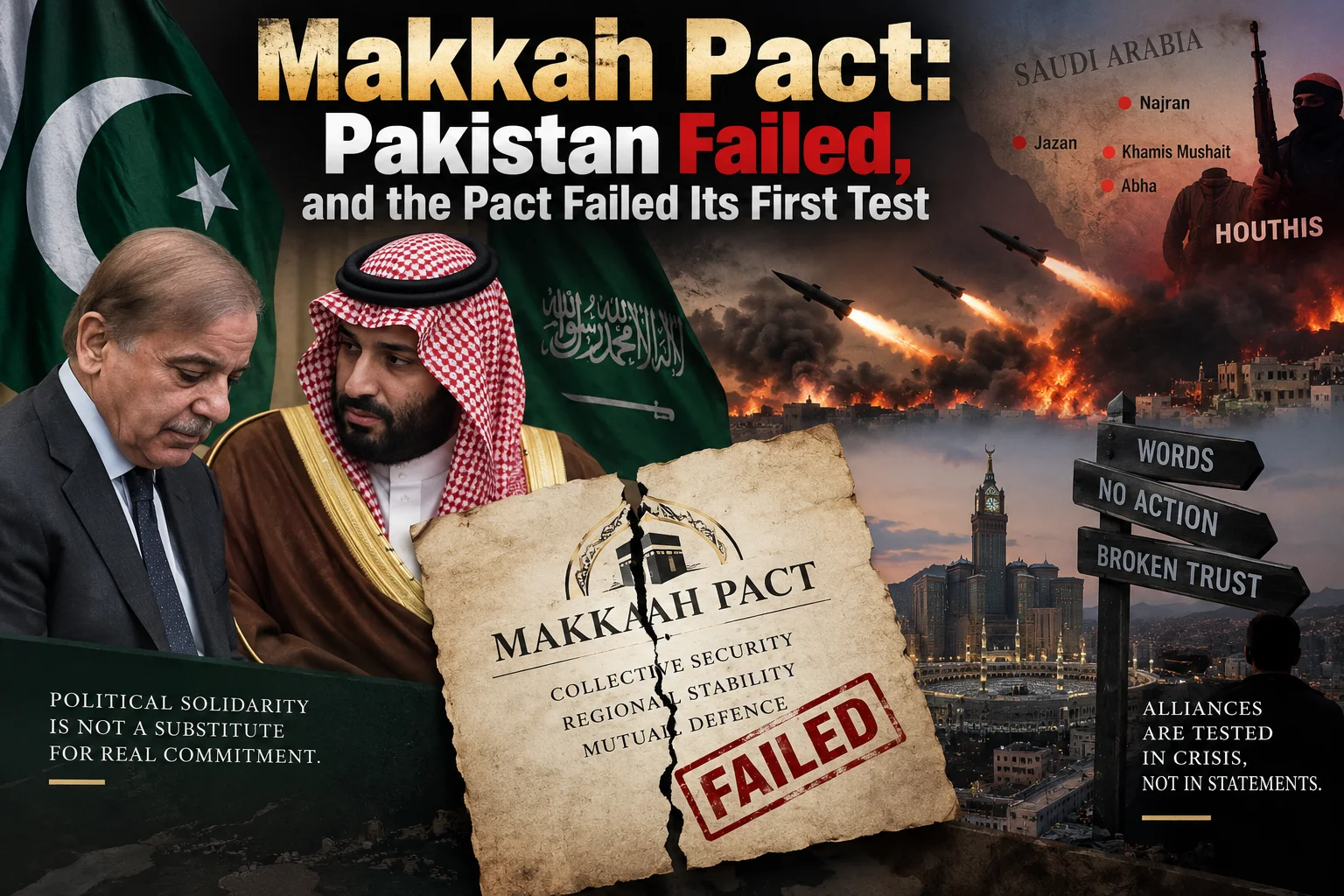
Pakistan’s response to Houthi attacks on Saudi Arabia has exposed a fundamental question over the practical value of the Makkah Pact: how far is Islamabad prepared to go when the security of a partner is directly threatened?
For an agreement presented around the principle that an attack on one member should concern all members, Pakistan’s conduct has so far been notably cautious. Islamabad has condemned the attacks, warned the Houthis that aggression against Saudi Arabia could invoke the pact, and reaffirmed its support for Riyadh. But it has also made clear that no military response is currently under discussion.
That distinction is important. From an Indian geopolitical perspective, the episode highlights the difference between political solidarity and operational collective defence. The former is relatively easy to demonstrate through statements and diplomatic support. The latter requires governments to accept military, financial and political risks.
Saudi Arabia has faced Houthi missile and drone attacks affecting areas including Abha, Khamis Mushait, Jazan and Najran. Pakistan has described some of the attacks as targeting Saudi civilian and economic sites and has publicly condemned them.
On September 8, Islamabad warned the Houthis that an attack on Saudi Arabia could trigger the pact's collective-defence principle. The statement appeared to give substance to the idea that the security of one member could become a concern for the others.
But Pakistan subsequently clarified that military action was not being discussed.
That qualification has exposed the central ambiguity surrounding the arrangement. If the pact is primarily a political commitment, Islamabad’s response is consistent with a conventional diplomatic posture. If it is intended to function as a genuine collective-defence mechanism, however, the absence of any announced military contribution raises questions about how the commitment would work during a serious conflict.
The issue matters beyond the immediate Houthi crisis because Pakistan has sought to use its relationships with Saudi Arabia and Türkiye to enhance its strategic position. A broader security framework could, in theory, give Islamabad greater diplomatic weight and strengthen its role in the Muslim world.
But alliances do not eliminate national interests. Saudi Arabia, Türkiye and Pakistan each have their own security priorities, economic considerations and regional relationships. None can be assumed to accept unlimited military obligations simply because of political alignment.
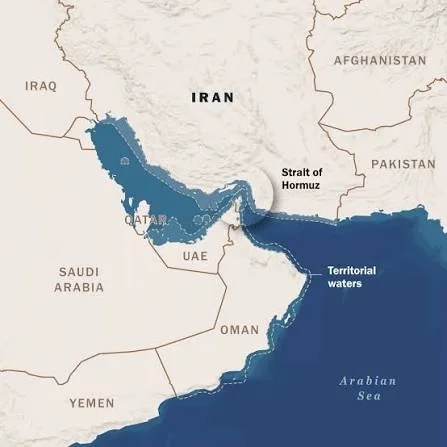
Pakistan’s position becomes even more complicated in the event of a wider Saudi-Iran confrontation.
Islamabad shares a border with Iran and has strong reasons to avoid direct military confrontation with Tehran. A decision to fight Iran in defence of Saudi Arabia would carry consequences for Pakistan’s own border security, economy and regional diplomacy.
This is where the Makkah Pact faces its more difficult credibility test. The question is not whether Pakistan supports Saudi Arabia politically. It clearly does. The question is whether Islamabad would accept the costs of military intervention if Saudi Arabia faced a sufficiently serious threat.
So far, the answer remains unclear.
For India, that ambiguity is strategically relevant. Pakistan has traditionally sought political and diplomatic support from friendly Muslim-majority states, particularly when dealing with disputes involving India. But the logic of collective security also imposes obligations on the country seeking such support.
If Pakistan expects partners to stand behind it during a confrontation, those partners can reasonably be expected to examine Islamabad’s own willingness to assume risks on their behalf. A security arrangement based largely on political declarations is unlikely to provide the same deterrent effect as one backed by clearly understood military commitments.
This does not mean that the Makkah Pact has no strategic significance. Defence cooperation, military relationships and political coordination can have value even without automatic troop deployments. But its practical limits become visible when an actual security crisis arrives.
The Houthi attacks have therefore exposed an uncomfortable asymmetry. Pakistan has invoked the collective-defence principle while simultaneously avoiding any commitment to military action. That may reflect a deliberate effort by Islamabad to preserve its relationship with Saudi Arabia without becoming directly involved in another regional conflict.
From a Pakistani perspective, that may be a rational calculation of national interest. From the standpoint of alliance credibility, however, it creates a problem.
The more expansive the language of collective defence, the greater the expectation that members will demonstrate both the capability and willingness to act when another member is threatened. Diplomatic condemnation alone cannot establish that credibility.
The immediate crisis may pass without requiring Pakistan to make that choice. But the question raised by it will remain: when collective security becomes a real military obligation rather than a political declaration, where exactly does Pakistan draw the line?
Until that question has a clearer answer, the Makkah Pact remains stronger as a framework for political and defence alignment than as a demonstrated collective-security guarantee.
Ravish Handoo is a geopolitical analyst, television commentator, and regular participant in television debates on national and international affairs.