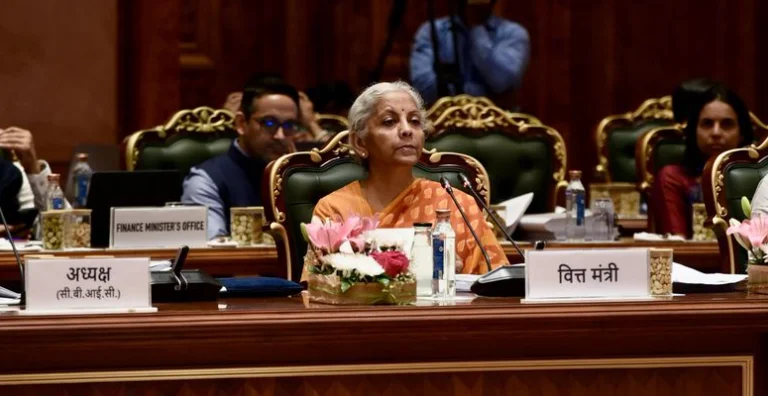
New Delhi, October 8: The GST Council, chaired by Union Finance Minister Nirmala Sitharaman and comprising state finance ministers, on Thursday began deliberations on a series of proposed reforms aimed at making the Goods and Services Tax regime more taxpayer-friendly and improving the ease of doing business.
At its 57th meeting, the Council is considering major changes under the proposed GST 2.0 framework, including scrapping the arrest powers of GST officers, decriminalising several offences and simplifying the registration process.
The Council is expected to deliberate on removing criminal liability for nine offences, softening provisions for 24 others and raising the threshold for initiating criminal prosecution from the existing level to ₹5 crore.
Under the proposed changes, taxpayers involved in offences such as delayed return filing, classification disputes or delays in tax payment due to cash-flow issues may avoid arrest by paying the applicable tax, interest and proportionate penalty. GST officers would primarily focus on tax recovery, while law enforcement agencies would handle criminal proceedings.
At present, GST officers can arrest individuals, with prior authorisation from a Commissioner-level officer, in serious cases involving tax evasion, fraudulent input tax credit (ITC) claims or wrongful refunds exceeding ₹1 crore.
The Council is also likely to consider a common procedure for raising GST demands across states. Taxpayers could receive a mandatory intimation before a formal notice, providing them an opportunity to respond. No GST notice may be issued for demands below ₹10,000, a category that currently accounts for around 20 per cent of cases by number but involves a negligible amount of tax.
To tackle fake input tax credit and discrepancies between buyer and supplier claims, the Council may consider introducing an invoice-matching system in monthly GST returns. The system would enable reconciliation of invoices and help ensure legitimate credit claims.
Several measures aimed at easing compliance for small businesses are also on the agenda. Small sellers operating through e-commerce platforms may be allowed to use platform warehouses as their registered place of business in states where they do not have their own premises.
Under the proposal, such suppliers would need a physical place of business in only one state, where physical verification and Aadhaar authentication would be completed. Registrations in other states could then be processed with the consent of the platform without direct involvement of tax officers. The move could benefit around 9.5 lakh small sellers seeking access to customers across the country.
The Council may also consider redesigning GST registration forms to make the process simpler, with step-by-step guidance and clear document requirements. Taxpayers already registered in another state could have their details carried forward, reducing the paperwork required for registrations in multiple states.
Another proposal seeks to limit GST rate revisions to once a year, with changes taking effect from the beginning of a financial year, providing greater predictability and stability for businesses.
The Council is also expected to discuss intelligence-led logistics and transit checks. Under the proposed system, vehicles would be stopped only on the basis of specific prior authorisation from a senior officer and generally by the state of origin, except in cases involving missing documents or buyer-liable tax. The move is aimed at reducing multiple stoppages, transit delays and freight costs.
For exporters, the Council may consider aligning the definition of exports with commercial activities involving foreign exchange earnings and removing ambiguity regarding the export status of services supplied through overseas branches of Indian companies.
ExploreHistoryThe meeting may also take up a proposal to withdraw the IGST exemption currently available on imports of gold, silver and platinum by specified banks and nominated agencies. These precious metals generally attract 3 per cent IGST, but the exemption is available to certain designated importers.
Another proposal under consideration would allow employers to claim input tax credit on premiums paid for life and health insurance coverage provided to employees. While individuals purchasing such policies for themselves or their families are eligible for GST exemption, companies currently pay 18 per cent GST on employee insurance coverage without being able to claim ITC.
The Council is also likely to discuss restructuring its officers’ committees to make the mechanism more streamlined. The existing structure, comprising the Secretariat, an implementation committee, eight standing committees and 18 sectoral groups, may be consolidated into three bodies — the Secretariat, the Implementation Committee and a single Standing Committee of officers.
The proposed reforms are expected to be implemented in a phased manner beginning early next year, subject to the Council’s decisions and subsequent legal changes.