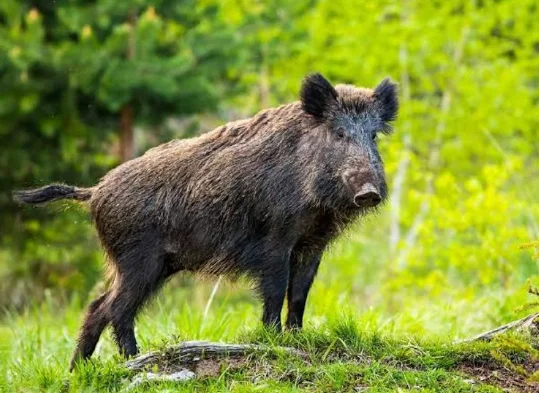
SRINAGAR, Sept 5: Scientists in Kashmir have launched a genetic study to determine the origin, population history and spread of wild boars that have resurfaced in various parts of the Kashmir Valley.
Professor Khursheed Ahmed, Head of the Division of Wildlife Sciences at Sher-e-Kashmir University of Agricultural Sciences and Technology of Kashmir (SKUAST-K), said a sample of the animal has already been collected and genetic analysis will be conducted to establish its links with wild boar populations in Jammu and other parts of mainland India.
“We want to establish genetically whether their relatedness is with the main population in Jammu or mainland India, or with populations on the other side of Kashmir, beyond the Line of Control,” he said.
The study comes amid increasing concerns over the growing presence of wild boars in the Valley, with farmers in several areas reporting extensive damage to agricultural and vegetable crops.
Wild boar is not considered native to Kashmir and was declared locally extinct in the region in the 1980s. According to Professor Khursheed, the species was introduced during the reign of Maharaja Gulab Singh, particularly in forest areas around Dachigam National Park and adjoining regions for hunting.
The species resurfaced in Kashmir in 2013, when three wild boars were reported in Dachigam, nearly three decades after the last sighting in 1984.
The ongoing study will initially examine the genetic relationship between the Kashmir population and wild boars in Jammu. Researchers will subsequently study the population genetics of wild boars across different parts of the Valley.
“We are going to see the population genetics—whether the populations in the north and south, as well as those in between, are mixing or remain separate,” Khursheed said.
The research is expected to determine whether wild boars found across Kashmir belong to a single interconnected population or comprise separate populations. It could also provide insights into gene flow, movement patterns and the factors driving the species’ expansion.
Khursheed said the university recently initiated the study and the genetic analysis is expected to take around five to six months. A population census is also planned, as the exact number of wild boars currently present in Kashmir is not known.
Wild boar incursions have been reported from several parts of the Valley. In Bandipora’s Ajas area, for instance, widespread incidents prompted the district administration to consult the wildlife department at SKUAST-K.
Experts informed the administration that the species was not native to Kashmir and could potentially be declared “vermin” under provisions of the Wildlife Protection Act, which would permit measures to control its population.
However, Khursheed stressed that a scientific assessment of the population was necessary before any such action could be considered.
“If range expansion has happened, how it has happened and what factors are responsible for this expansion—we have to study that also,” he said.
He noted that wild boars are fast-breeding animals, with females capable of producing large litters. Camera-trap images have recorded as many as 14 young ones accompanying a female, highlighting the species’ potential to multiply rapidly.
Experts have also suggested that rising temperatures could be contributing to the species’ resurgence in Kashmir, as wild boars may previously have struggled to survive the Valley’s traditionally colder climatic conditions.
The genetic study is expected to provide scientific evidence about the origin, genetic connectivity and expansion of wild boars in Kashmir, while helping authorities assess their potential ecological and agricultural impact.