New Delhi, Sep 14: Several strategic affairs experts on Monday hailed the BRICS Summit’s joint declaration as a "diplomatic breakthrough" for India – with consensus forged under its chairship – while others termed the grouping's stand as an "endorsement" of New Delhi's call for zero tolerance towards any form of terrorism.
They also said the BRICS leaders condemning in the "strongest terms" the Pahalgam terror attack in Jammu and Kashmir last year that killed 26 people, made the New Delhi Declaration even "more significant" for India.
The grouping adopted the consensus joint declaration on September 12 after overcoming sharp divisions between the United Arab Emirates and Iran regarding the West Asia conflict while notably omitting direct mention of the US for its attacks on Iran.
The negotiations on the text of the declaration went down to the wire as both Iran and the UAE had hardened their positions initially.
Former diplomat Veena Sikri, who served as India’s high commissioner to Bangladesh from 2003-2006, described the declaration as a "tremendous diplomatic breakthrough for India".
"There's no ifs and buts now. India is at the high table of the world today. And the big breakthrough is largely the results of (the Indian) prime minister's bilaterals, which he had with (Iranian) President Masoud Pezeshkian and Abu Dhabi Crown Prince (Mohamed bin Zayed Al Nahyan), as also of course, the entire team led by Sherpa, Ambassador Sudhakar Dalela and the minister, they all have worked round the clock. They had been talking to everybody till 3-4 am in the morning trying to get a text," she said.
The bilateral meeting between the Abu Dhabi crown prince and the Iranian president in Delhi was also significant, Sikri said, pointing to the backdrop of the ongoing conflict in West Asia.
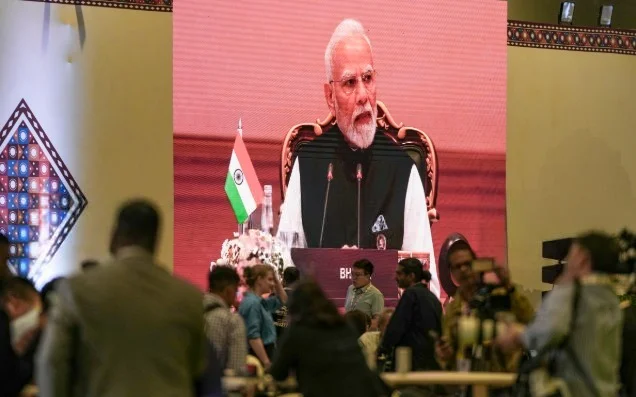
Prime Minister Narendra Modi had announced the adoption of the declaration at the end of the opening day's deliberations in the presence of Chinese President Xi Jinping, Russian President Vladimir Putin, the Iranian president, the Abu Dhabi crown prince and other top leaders of the bloc.
Sikri said the context of the New Delhi declaration is very significant as India has always said and believed that BRICS is a non-West grouping, but it's "not an anti-West grouping", and that came through "very clearly".
Former foreign secretary Nirupama Menon Rao in a post on X said the BRICS Summit in Delhi "offered an important picture of India's place in a fragmenting world".
“New Delhi clearly sees value in a grouping that is non-Western, but little advantage in allowing it to become explicitly anti-Western. The objective is reform without rupture: a more representative international order, greater agency for the Global South and protection against economic coercion, without abandoning access to Western markets, capital and technology," she wrote.
That distinction was made explicit by Prime Minister Modi when he said BRICS was "not against anyone", Rao said, adding that India resisted attempts to turn the meeting into a platform of anti-American rhetoric.
"We did not witness endorsement of a common BRICS currency or dramatic declaration of de-dollarisation. The focus remained on national-currency settlements, faster cross-border payments, resilient supply chains, digital public infrastructure, health, food and energy security, and reform of the UN, IMF and World Bank.
"India scored a significant diplomatic success in securing a unanimous New Delhi Declaration despite sharp differences between Iran and the UAE over West Asia. Consensus was preserved, but only through carefully generalised language," she added.
In the context of the West Asia conflict, BRICS leaders in the declaration have called for exercising "maximum restraint", as well as avoiding actions that could further aggravate the situation.
India has often maintained that dialogue and diplomacy is the way forward to resolve any conflict.
Vishal V Sharma, ambassador and permanent representative of India to UNESCO, described the declaration as "a major diplomatic endorsement of India's global leadership".
Ahead of the Summit, over 400 meetings and engagements were held across 30 Indian cities, he said.
"BRICS is an alignment for the future, which means stronger partnership in a multipolar world. So, I think this has been a tremendous acknowledgment of India's global leadership, and it has come at a very crucial time, which shows that the countries in the world want stability," Sharma told PTI over phone from Paris.
He also hailed the grouping's stand on terrorism and the leaders condemning the Pahalgam terror attack.
In the declaration, BRICS fully backed India's call for zero tolerance towards any form of terrorism and shunning double standards in countering the menace, as the top leaders of the influential grouping agreed to have a concerted approach in dealing with the challenge.
He also underlined that BRICS leaders have called for protection of cultural heritage, including in regions affected by conflict, and laid emphasis on repatriation of antiquities and objects of spiritual, ancestral, historical a