Kathmandu, Aug 28: The death toll from flash floods in central Nepal rose to 547 on Friday, with more bodies recovered as search and rescue operations continue with caution due to fear of fresh floods following an increase in the water level in the Bhotekoshi River area.
The National Disaster Risk Reduction and Management Authority (NDRRMA) said rising water levels at the site of a devastating flash flood earlier this week increased the risk of another flood in the area.
"The water level mixed with mud has increased at the same place where the flash flood occurred on Wednesday, and there is a risk of more flooding in the area," the NDRRMA said.
The warning comes after a massive flash flood swept through Rasuwa and other parts of central Nepal on Wednesday, killing hundreds and causing widespread damage to settlements, roads, bridges and hydropower infrastructure.
The NDRRMA urged people involved in search and rescue operations, as well as those staying in the Bhotekoshi and Trishuli areas for various reasons, to remain highly alert and immediately move to safer places if they face any risk.
Nepal Police on Friday said 547 bodies were recovered from eight districts of the Himalayan nation, with thousands still missing.
According to the police, 134 dead bodies were recovered from Nawalparasi East, 221 from Chitwan, 44 from Gorkha and 38 from Nuwakot.
Similarly, 40 bodies were recovered from Dhading, 29 from Tanu, 28 from Nawalparasi West and 13 from Rasuwa.
Five people have been killed in Gyirong County in the Tibet Autonomous Region, according to Chinese authorities.
At least 977 people, including 86 security personnel, 517 foreign tourists and 127 Nepali travellers, have been missing since Wednesday morning when the flash floods hit Rasuwa and adjoining districts of Nepal.
So far, 1,545 injured and stranded people have been rescued from various affected regions. Among them, 84 are currently undergoing treatment in various hospitals in Kathmandu, where families are desperately searching for their loved ones.
Nepal Tourism Board has informed that so far 121 foreign tourists, including 85 Indians, 9 South Koreans and 16 Chinese nationals, have been rescued from various flood-affected regions till Friday afternoon.
Search and rescue operations continued for the third day of the tragic
incident with the mobilisation of 7,451 security personnel, including 2,391 Nepal Army personnel, the police statement said.
Helicopters have been used to reach isolated areas and evacuate survivors, while ground teams continue searching riverbanks and downstream settlements, The Kathmandu Post newspaper reported.
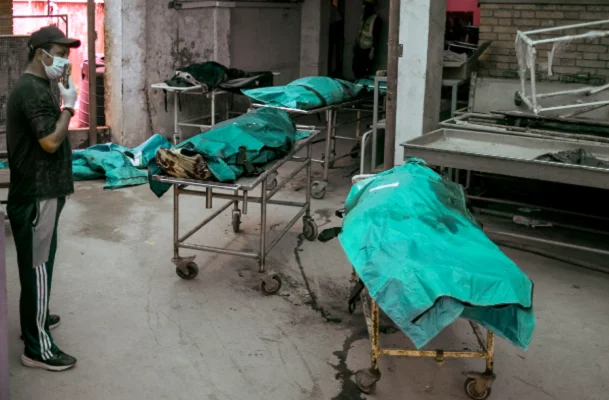
Morgues in hospitals in Nepal in several areas are running out of space as more bodies swept away by the floods downstream are being recovered.
Bodies recovered from Rasuwa and Nuwakot have been found as far downstream as Chitwan, Tanahun, Nawalparasi, Gorkha and other districts, with morgues in several areas running out of space, The Kathmandu Post reported.
Meanwhile, the Nepal government has decided to halt all examinations from August 29, given the situation that developed following the devastating natural disaster.
Nepal Prime Minister Balendra Shah and members of his cabinet have decided in a cabinet meeting to donate a month's salary to the disaster relief fund.
The cabinet also directed the finance ministry to prepare a relief, concessional financing and rehabilitation package for individuals and businesses affected by flash floods.
Meanwhile, China sounded a Level-IV alert late on Thursday, saying a large barrier lake had formed near the confluence of the Chhochen Khola and Purepu Tsangpo rivers in Nepal. China’s emergency response system for natural disasters has four levels, with Level-I being the highest and Level IV the lowest.
On Thursday, Nepal's Department of Hydrology and Meteorology had warned of a fresh flood risk downstream of the Bhotekoshi River following the formation of a new barrier lake near the Nepal-China border.
Chinese authorities had informed Nepal that around 2 million cubic metres of water had accumulated in the lake, with another 3 million cubic metres potentially entering it over three days, raising concerns about a possible breach.
The lake had formed near the confluence of the Chhochen Khola and Purepu Tsangpo rivers, which originate in Tibet and flow into Nepal as part of the Bhotekoshi river system.