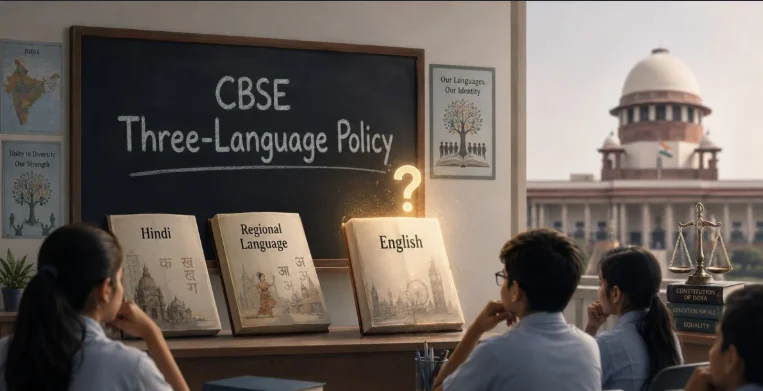
NEW DELHI, SEPTEMBER 3: The Centre on Thursday informed the Supreme Court that it was working on modalities for implementing the CBSE’s three-language policy for Class 9 students, under which at least two of the three languages are required to be native Indian languages.
Additional Solicitor General Aishwarya Bhati, appearing for the Centre, told a bench comprising Chief Justice of India Surya Kant and Justices Joymalya Bagchi and V Mohana that the CBSE was examining various aspects of the policy and sought additional time.
Taking note of the submission, the Supreme Court deferred the matter for a week.
The court had on August 20 emphasised that children should not be subjected to undue pressure while implementing the policy. It said there was nothing inherently wrong with introducing the three-language requirement but observed that concerns had been raised over the manner of its implementation.
The bench had asked the authorities to revisit issues and streamline the policy to address practical impediments, including the availability of adequate human resources for teaching the languages offered by schools.
The Supreme Court had on May 27 agreed to hear a petition challenging the CBSE policy and issued notices to the Centre, CBSE and NCERT.
Under a CBSE circular issued on May 15, the study of three languages—R1, R2 and R3—became compulsory for Class 9 students from July 1, 2026, with at least two languages required to be native Indian languages.
Students opting for a foreign language can study it only as the third language after choosing two native Indian languages, or as an additional fourth language.
The policy is part of the CBSE’s alignment of its scheme of studies with the National Education Policy (NEP) 2020 and the National Curriculum Framework for School Education 2023.
The CBSE has also clarified that no board examination will be conducted for R3 at the Class 10 level. Until dedicated R3 textbooks are available, students will use Class 6 R3 textbooks of the chosen language.