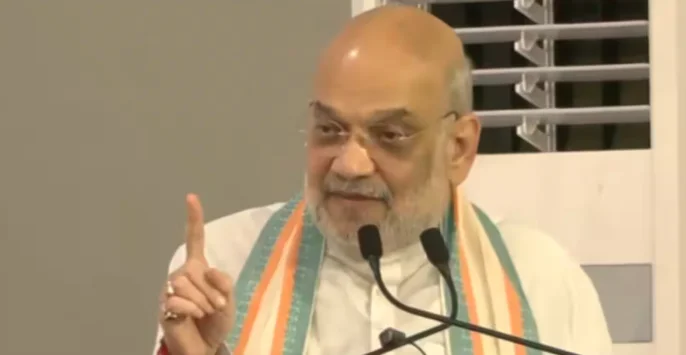
AHMEDABAD, Sept 27: Union Home Minister Amit Shah on Sunday flagged off India’s first LNG-powered train from Sabarmati station in Gujarat and highlighted the railway modernisation initiatives undertaken under the Narendra Modi-led government.
Addressing a gathering after the flag-off, Shah credited Prime Minister Narendra Modi with transforming the Indian Railways and contrasted the government’s record with that of previous Congress-led administrations.
Shah said major initiatives such as dedicated freight corridors, rapid rail systems, modern railway stations and new train technologies had been introduced during the Modi government’s tenure.
He also criticised the Congress, alleging that previous governments were marked by scams and corruption. Shah claimed that the Congress-led governments were involved in corruption worth Rs 12 lakh crore, while asserting that no corruption allegation had been established against Modi during his 12 years in office.
During the programme, Shah also flagged off a WAG-12 electric locomotive and dedicated, inaugurated or laid foundation stones for railway projects worth more than Rs 1,500 crore.
The projects include railway line doubling, the Kavach train protection system, automatic signalling and a maintenance shed for WAG-12 electric locomotives.
Shah said the successful trial of a long double-stack container train between Mumbai and Vadodara would increase freight-carrying capacity and help address limitations in railway infrastructure.
He said the Modi government had introduced several measures to modernise the railway network since 2014, including expansion of freight corridors and upgrading existing infrastructure.
According to Shah, around 11,000 km of railway corridors are being upgraded to four-track networks to improve passenger and freight movement.
He also highlighted improvements in railway electrification, safety and locomotive manufacturing. Shah said 97 per cent of bio-toilets in trains had been installed or upgraded during the Modi government’s tenure, while 87 per cent of LHB coaches were being produced domestically.
He claimed that railway electrification had increased substantially, while the railway safety budget had risen by 67 per cent and locomotive production capacity by 66 per cent.
Shah also pointed to the reduction in diesel consumption by the Railways, saying it fell from around 293 crore litres in 2015-16 to 108 crore litres in 2024-25, with the government targeting zero diesel consumption in railway operations by 2030.
He said annual railway electrification had increased from around 75 km in 2010-11 to 7,188 km in 2023-24, and claimed that 99.6 per cent of the railway network had been electrified.
Shah also compared India’s railway electrification level with that of countries including China, Spain, France and Britain, saying India was moving towards complete electrification.
On Gujarat, Shah said the state’s railway budget allocation had increased from Rs 589 crore during 2009-14 to Rs 17,366 crore in 2026-27, according to figures cited by him.
Gujarat Chief Minister Bhupendra Patel, Deputy Chief Minister Harsh Sanghavi and senior railway officials were present at the event.